
Our Specialisms
Lime Plastering & Lime Render
for Heritage Buildings
Breathable, traditional lime plaster and lime render for listed buildings, period homes and conservation projects. We work with architects, conservation officers, main contractors and private clients across London, the South East and Buckinghamshire.
What is lime plastering?
Lime plastering is the traditional way of finishing walls and ceilings with plaster made from burnt limestone, sand and water. Before gypsum and cement became common in the twentieth century, almost every building in Britain was plastered and rendered in lime.
The key difference is breathability. Lime is vapour-permeable, so moisture in solid masonry can move through the wall and evaporate. Gypsum and cement are much less permeable: applied to an old solid wall they tend to trap moisture behind them, leading to damp, salts, decay in timber and plaster that blows off the wall. Lime is also softer and more flexible, so it tolerates the slight movement of old buildings, and as it carbonates it can heal fine cracks.
For listed buildings and most properties built before about 1920, lime is not just the sympathetic choice — it is often what the conservation officer or listed building consent will require.
Why It Matters for Heritage Buildings
- Prevents moisture entrapment that leads to damp and structural damage
- Sympathetic to the natural movement of old masonry and timber
- Required by many conservation officers and listed building consents
- Self-healing micro-cracks through carbonation over time
- Authentic visual and tactile character impossible to replicate with modern plaster
- Environmentally lower-impact than cement-based alternatives
Our lime plastering process
Every project begins with a thorough assessment of the substrate and existing fabric. We work closely with architects, conservation officers, and main contractors to select the correct specification.
Assessment
survey of the existing fabric, moisture readings and discussion of the specification with the project team.
Specification
lime type, aggregate, mix and number of coats appropriate to the background and conservation requirements.
Application
scratch, float and finish coats, each allowed to cure properly.
Completion
inspection, snagging and handover, with aftercare advice on decoration (breathable paints, limewash) and drying out.
Aftercare: can a breathable lime repair be defeated by wallpaper?
Choice Finishes
Talk to us about your heritage project
We can help with lime selection, substrate assessment and conservation-led sequencing.
Lime plastering for listed buildings and period properties
Many of London's most desirable addresses — in Chelsea, Kensington, Belgravia, Mayfair, Hampstead and Notting Hill — sit within conservation areas or are listed. Outside London, we work on period homes across Buckinghamshire, Hertfordshire, Surrey and Berkshire, from timber-framed cottages to Georgian town houses.
On listed buildings we work with conservation officers and architects to agree materials and methods before starting, keep as much historic fabric as possible, and record what we find.
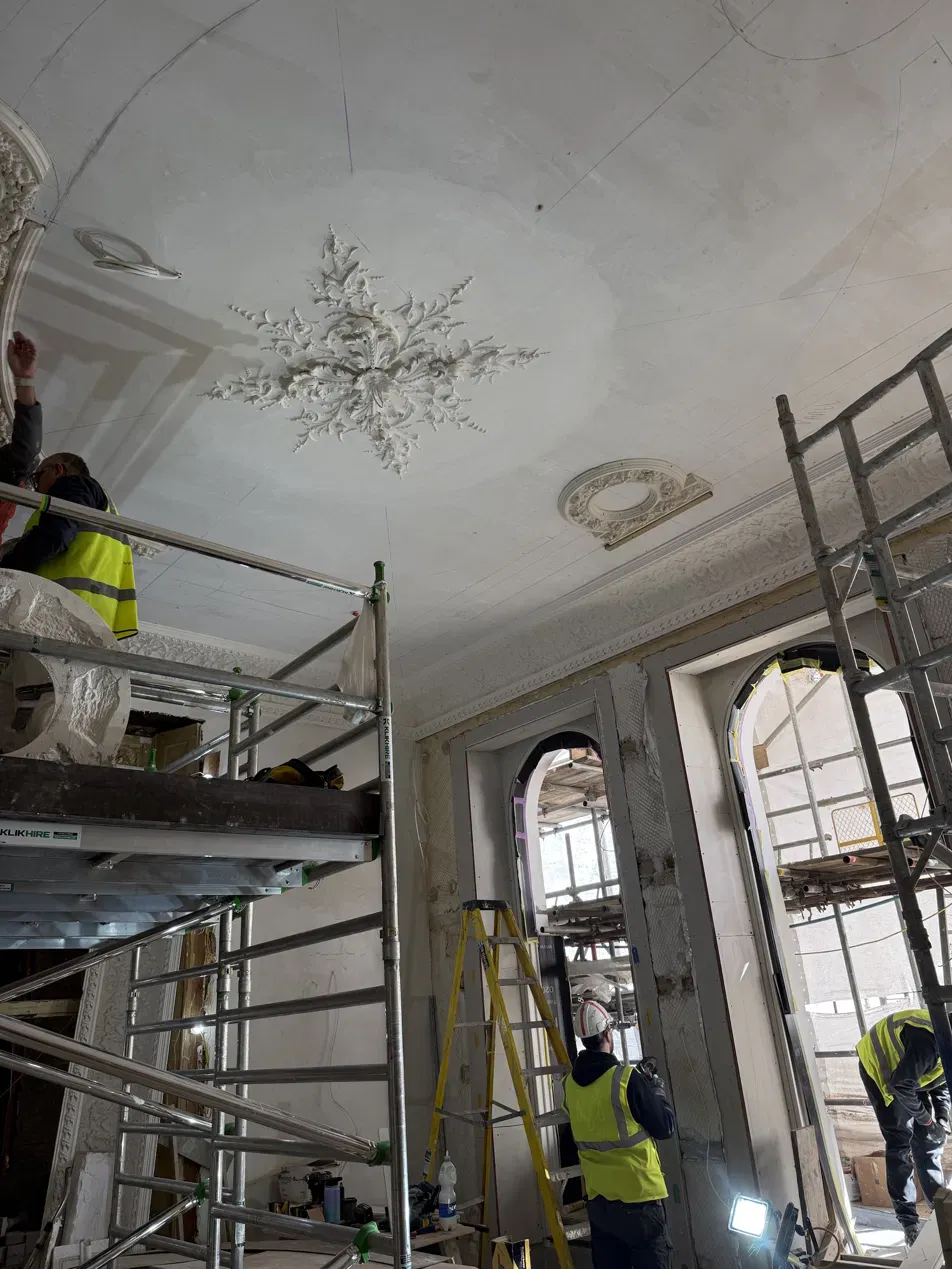
Traditional plastering in lime
Traditional lime plastering is built up in coats, each allowed to cure before the next:
- Scratch coat — keyed to give the next coat something to grip.
- Float coat — straightened and consolidated to bring the wall true.
- Setting (finish) coat — a fine lime finish, trowelled smooth or left with a softer texture.
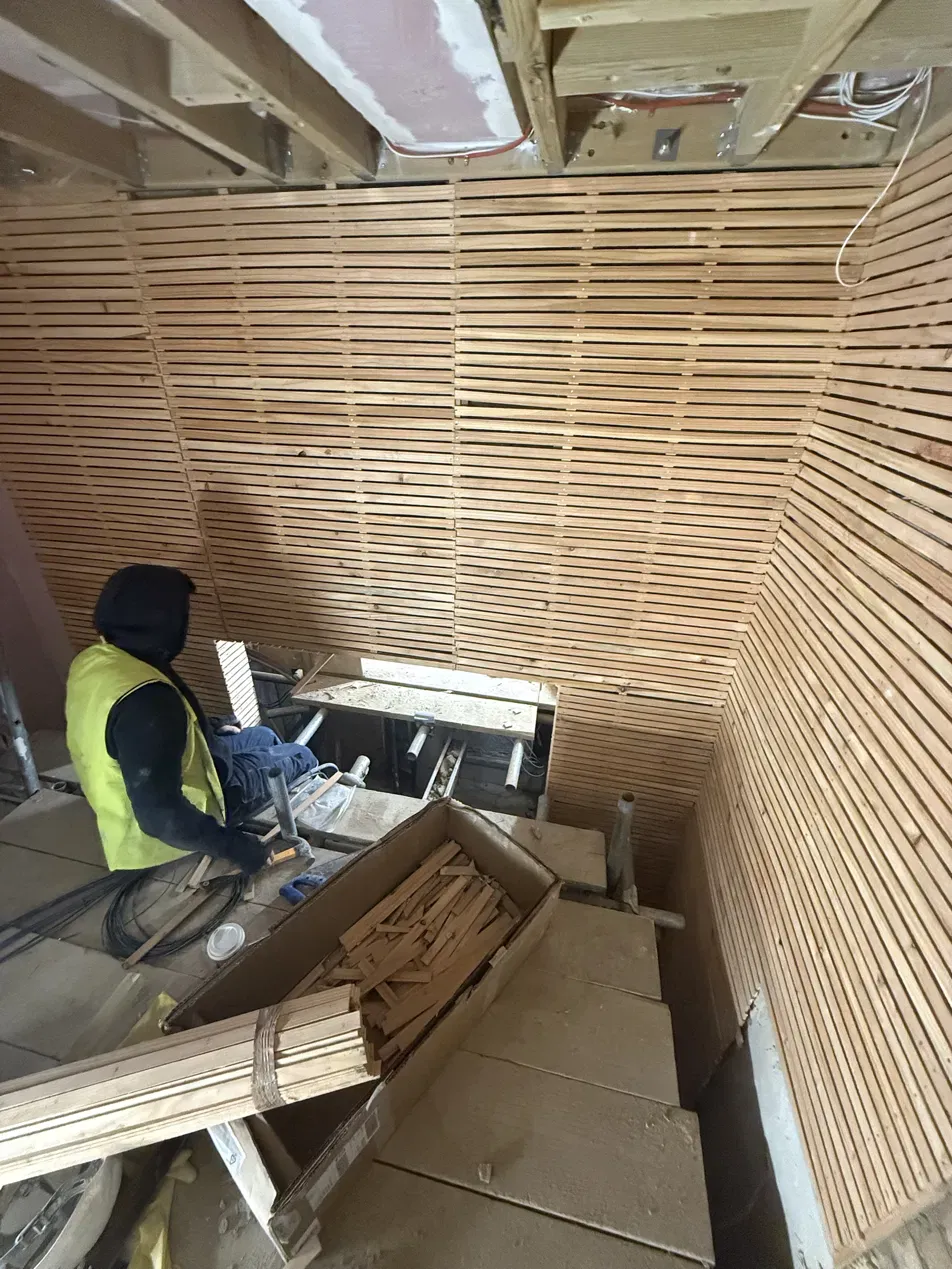
On ceilings and timber partitions we install lath and lime — riven or sawn timber lath fixed to the joists or studs, with haired lime backing coats pushed through the gaps to form a mechanical key. Where original lath survives and is sound, we keep it and repair around it.
We also carry out modern gypsum traditional plastering for extensions, new partitions and modern areas of the same building, and can run both systems side by side on one programme.
Lime render and external lime render
External lime render protects solid walls from rain while letting them dry out. For period elevations it is usually the correct replacement for failed or inappropriate cement render, which can crack, trap water and accelerate decay of soft brick and stone.
We apply external lime render to:
- Listed and period elevations, including full re-rendering after removal of cement render
- Stucco-fronted townhouses and mansard storeys
- Garden walls, outbuildings and boundary walls
- Repairs and patching matched to existing render
At Lancaster Gate we delivered the complete external render package from the fifth-floor mansard to ground, across six levels of a live heritage site, with a consistent finish across elevations completed months apart. See also our external rendering page.
Lime render specification
Getting the lime render specification right is the difference between a render that lasts for decades and one that fails in a few winters. We agree the specification with the architect or conservation officer and the client, covering:
- Binder: non-hydraulic lime putty, or natural hydraulic lime (NHL 2, 3.5 or 5) chosen for the exposure and the background. As a rule, the render should be weaker and more permeable than the masonry behind it.
- Aggregate: well-graded sharp sand, matched where needed to the colour and texture of existing work.
- Mix ratio and coats: typically two or three coats, with each coat no stronger than the one beneath.
- Hair or fibre: for backing coats where extra tensile strength is needed.
- Preparation: removing cement render and unsound material, raking joints, and dampening the background to control suction.
- Curing: protection from sun, wind, rain and frost, with misting so the lime carbonates properly. Lime work is seasonal; we plan external lime around the weather and avoid frost risk.
- Finish: float, sponge, roughcast or a limewash or breathable mineral paint.
If you have an existing specification from your architect or heritage consultant, we will price and work to it. If you do not, we can propose one for approval.
Case study: Lancaster Gate
Brought in 18 months into a three-year restoration, we mobilised up to 16 specialist plasterers and took on effectively the whole plastering scope: 4,000m² of traditional lime plaster applied back from bare brickwork, riven timber lath and lime where the original was beyond repair, the full external render, grassello di calce polished plaster, structural waterproofing to 13 basement vaults and the ornamental fibrous restoration. Read the Lancaster Gate case study.
Choice Finishes
Get a quote for your lime plastering
Share the property details and we can discuss the right approach for the existing fabric.
Related Specialisms
Our Specialisms
Tadelakt
Waterproof Moroccan lime plaster for bathrooms, wetrooms, and feature walls.
Learn moreOur Specialisms
Fibrous Plastering & Ornamental Restoration
Specialist cornice, ceiling rose, and period moulding work for London's finest period properties.
Learn moreOur Specialisms
Full Plastering Services
See our full range of plastering, rendering, and modern finishes across London.
Learn moreCase Study
Lancaster Gate Heritage Restoration
A three-year heritage restoration across 11 luxury apartments — lime and fibrous plastering at scale.
View case studyFor matching period mouldings, see our cornice restoration service.
Frequently Asked Questions
Answers to common questions we hear from clients, architects, and designers.
Lime is breathable and flexible, so it lets moisture escape from solid walls and moves with the building. Gypsum and cement can trap moisture in old masonry, leading to damp and plaster failure. For listed and most pre-1920 buildings, lime is the technically correct choice.
Get in Touch
Discuss your heritage project
Send us drawings, photographs or an existing specification and we will advise on lime selection, sequencing and programme. Call +44 7854 393865 or email choicefinishesltd@gmail.com.
Get a quote